Croatia sailing itinerary
By Jason Carter, Sea Sun Vacations · October 15, 2026 · 25 minute read
The best seven-day sailing trip in Croatia for a first visit runs from Šibenik to Dubrovnik: Skradin and Krka National Park, Split, Bol on Brač and Stari Grad on Hvar, Vis, Korčula, Pomena on Mljet, then Dubrovnik. In one week, that route covers the most famous city, islands and national park on the Dalmatian coast, with a swim stop every day and a different harbor every night.
To sail this itinerary, see Sea Sun’s Croatia private yacht cruise dates.
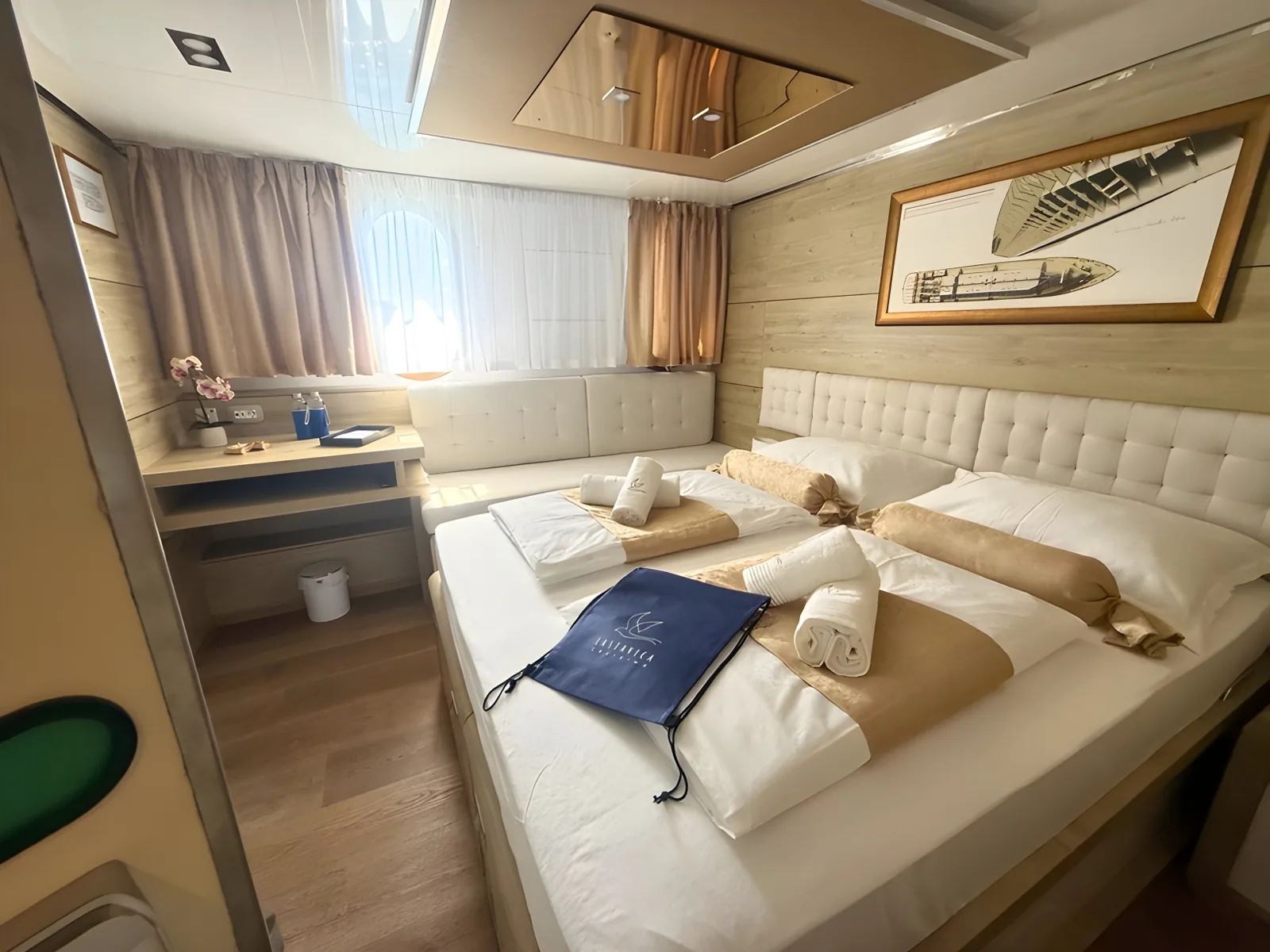
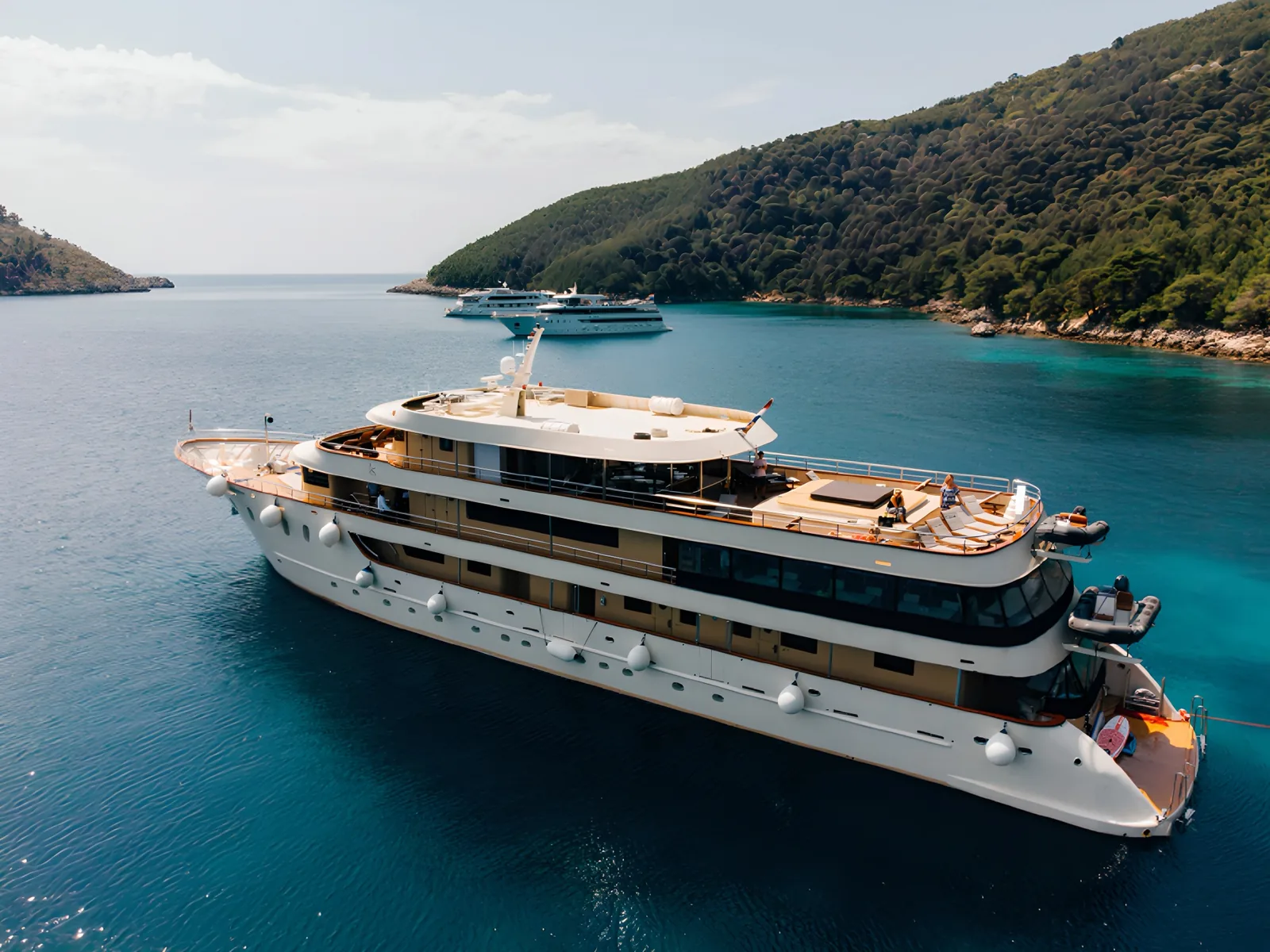
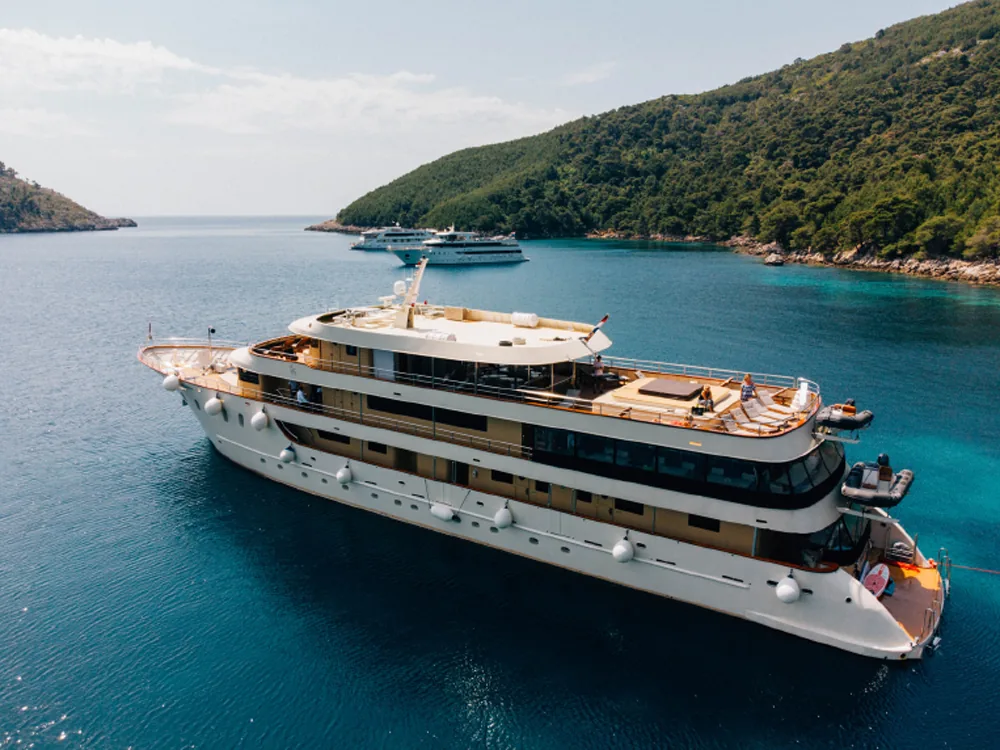
This is the itinerary of Sea Sun Vacations’ July 2027 sailing on our 18-cabin yacht, and it is the route many groups choose for a Croatia yacht charter of the whole yacht. Below, we go through it port by port: where the yacht sails, where to swim, what to explore ashore, and the local tips that make each stop better.
We are Sea Sun Vacations, a travel agency in Canton, Georgia, and Jason Carter plans these weeks with our travelers. Read more about Jason Carter and Sea Sun Vacations.
IN THIS GUIDE
01The week at a glance02How a sailing day works03Before the trip: arriving in Croatia04Day 1: Skradin and Krka National Park05Day 2: Split06Day 3: Bol on Brač and Stari Grad on Hvar07Day 4: Vis08Day 5: Korčula09Day 6: Pomena on Mljet10Day 7: Dubrovnik11Day 8: Departure from Dubrovnik12Food and wine along the route13Getting around ashore14Other ways to sail this coast in seven days
The week at a glance
| Day | Port | Highlights |
|---|---|---|
| 1 | Skradin | A riverside harbor at the gateway to Krka National Park and its waterfalls |
| 2 | Split | Diocletian’s Palace, the Riva and the beaches below Marjan hill |
| 3 | Bol and Stari Grad | Zlatni Rat beach on Brač and one of Europe’s oldest towns on Hvar |
| 4 | Vis | The most remote of the inhabited islands, and the Blue Cave on Biševo |
| 5 | Korčula | A walled medieval town on a small peninsula |
| 6 | Pomena | The quiet harbor of Mljet National Park, with its saltwater lakes |
| 7 | Dubrovnik | The old quarter walls and a last night in port |
| 8 | Dubrovnik | Breakfast on board and the end of the trip |
Ports always depend on the date, the weather and the captain’s judgment. On a private charter of the whole yacht, the route can be planned around your group.
How a sailing day works
Every sailing day in Croatia on this itinerary follows the same easy rhythm. Knowing it helps you plan your time.
Morning: breakfast and sailing
Breakfast is served on board. The yacht then leaves the harbor and sails to the next port. Most legs on this route are short, which leaves plenty of time to explore and enjoy the afternoon.
Midday: a swim in a quiet bay and lunch
Along the way, the boat stops in a quiet bay for a swim, often a bay you could only reach by sea. The water toys come out, and the sea in summer is warm and clear. Lunch is served on board on six days of the week.
Afternoon and evening: a new harbor
The yacht reaches the next port in the afternoon. From there, your time is your own. Explore the old streets, find a konoba for dinner and enjoy the evening. The yacht stays in port overnight, so there is no last boat to catch.
Before the trip: arriving in Croatia
Fly into Split
For this route, fly into Split and home from Dubrovnik. Split’s airport sits on the coast between Split and Trogir.
Spend a night before boarding
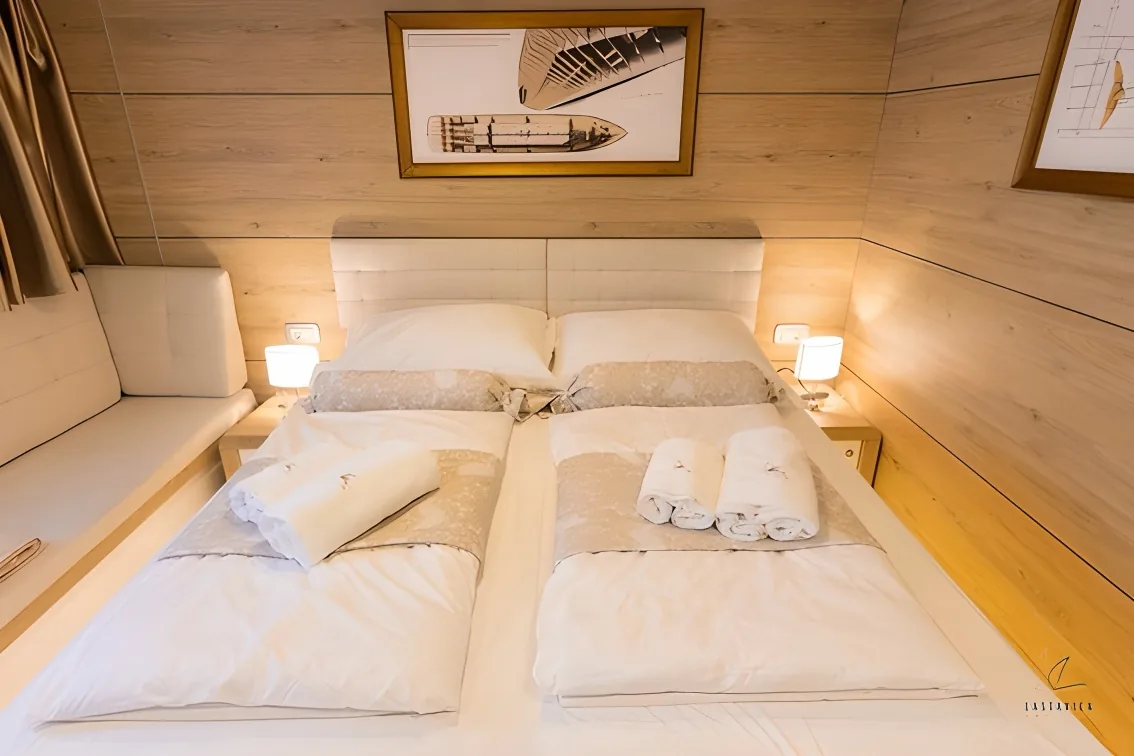
Flights from the United States arrive at all hours, so most travelers spend at least one night in Croatia before boarding. Two places work best.
Trogir. A small walled town on its own island, close to Split’s airport and listed by UNESCO for its medieval streets. It is a calm, easy first night, and the waterfront is a lovely place for a first dinner.
Šibenik. The port where the sailing begins. Staying here means no travel on boarding day, and the old quarter and its cathedral are worth an evening of their own.
What to bring
Pack light and soft, and bring less than you think you need. Luggage goes under the bed in the cabin, so a soft bag works far better than a hard suitcase. A small backpack is useful for time ashore.
| Bring | Why |
|---|---|
| Swimwear, two sets | You will swim every day, and one set is always drying |
| Reef-safe sun cream, a hat and sunglasses | The sun on the water is strong from late morning |
| Water shoes | Most beaches in Croatia are pebble or rock |
| Comfortable walking shoes | Old towns are paved with smooth, slippery stone |
| A light jacket or sweater | Evenings on deck can be cool in May, June and October |
| A smart-casual outfit | For the captain’s dinner and a nice dinner ashore |
| A small dry bag | For phones and cameras on small-boat trips |
| Any medicines you need | Pharmacies are easy to find in town, but not at sea |
| A plug adapter | Croatia uses the European two-pin plug and 220 volts |
Leave the hard suitcase and the hair straightener at home if you can, and bring a reusable water bottle.
Day 1: Skradin and Krka National Park
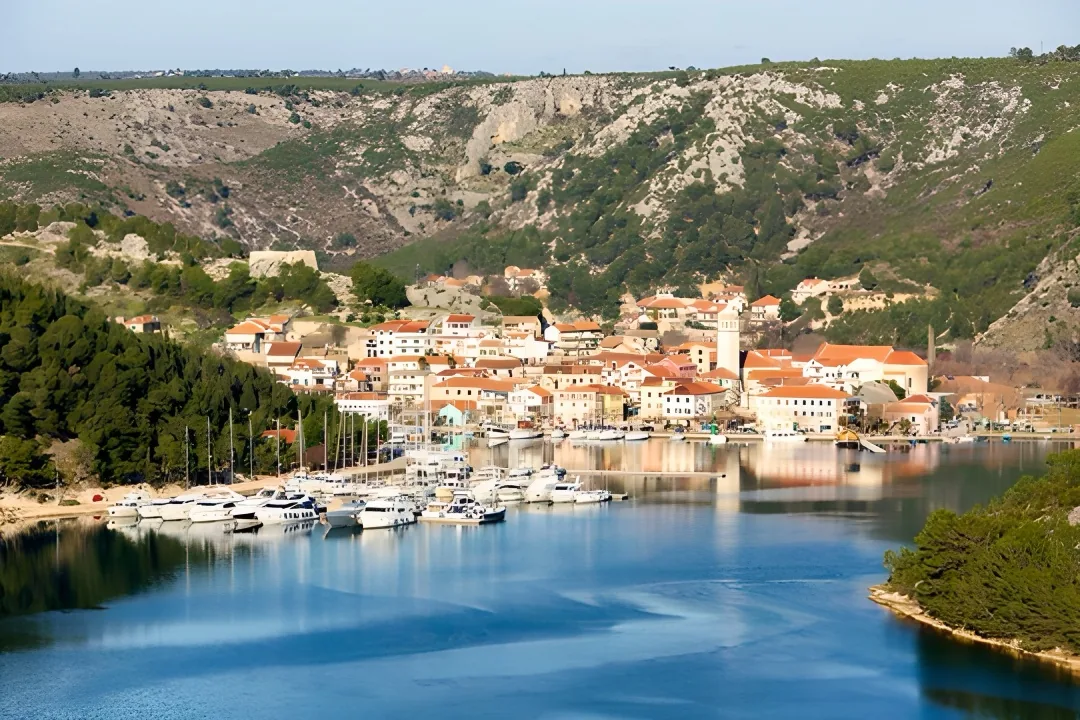
The trip starts in Šibenik, and the first port is Skradin, a short sail up the river.
The sail
The yacht leaves Šibenik and heads inland through the narrow channel below St. Nicholas Fortress, then up the Krka river. It is among the most unusual approaches to any port in Croatia: green hills, calm water and a small harbor at the end of the river.
Skradin
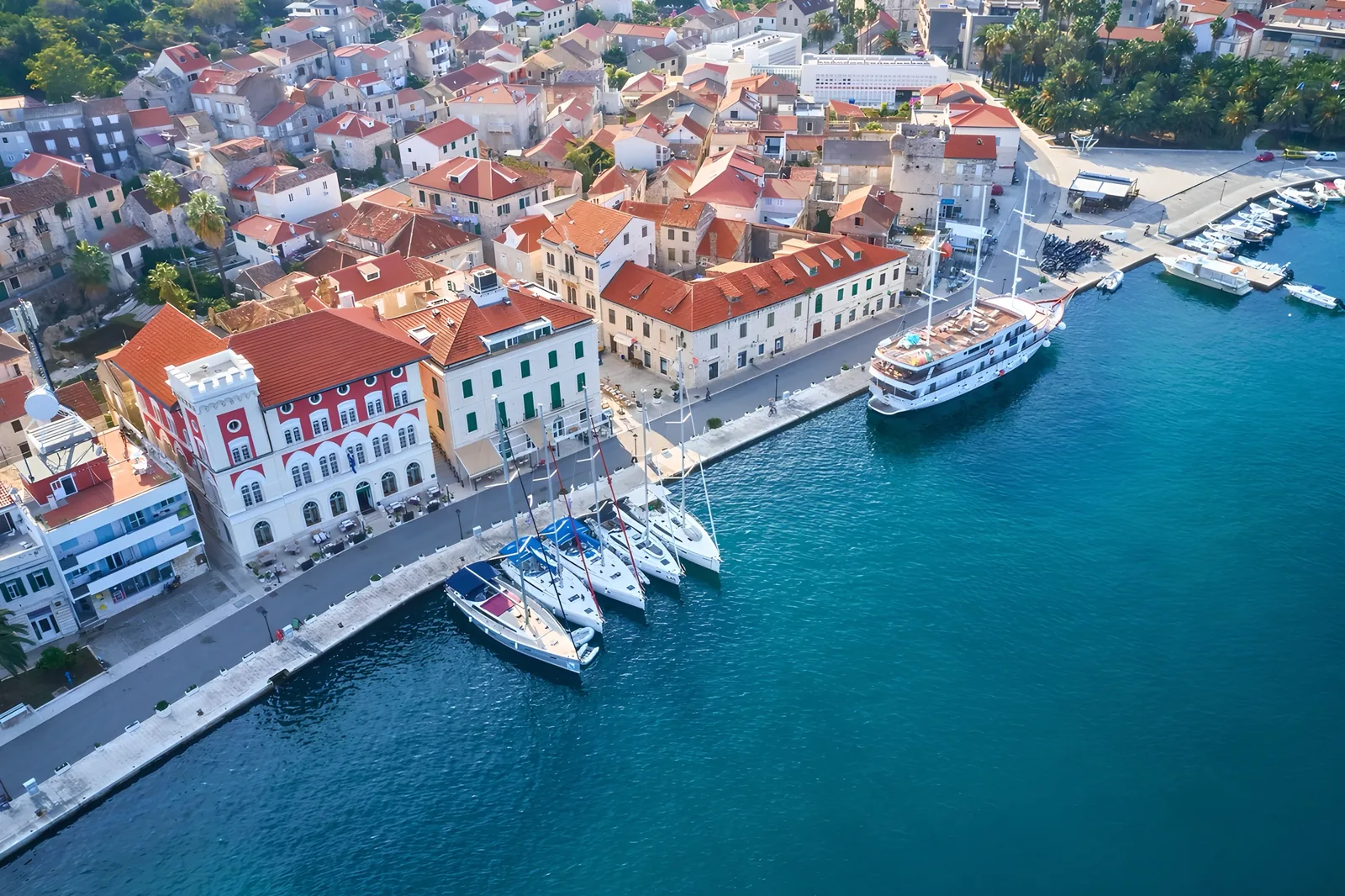
This riverside harbor is a small waterfront town with stone houses, a busy marina full of yachts and a handful of restaurants along the water. It is quiet, pretty and very easy to explore on foot in an hour.
Krka National Park
Skradin is the closest place to the lower falls of Krka National Park. The best-known falls, Skradinski buk, are a series of cascades and turquoise pools linked by wooden walkways. The park’s own boats and paths take visitors from the Skradin side to the falls.
Swimming under the falls has not been allowed since 2021, but the walk around them is still among the best experiences in Croatia. Go in the late afternoon, when the crowds have left.
Where to eat
Skradin is known for Skradin risotto, a slow-cooked local dish that takes hours to make. Ask whether a restaurant serves it, and order early in the evening.
Also worth seeing: Šibenik before you sail
If you board in Šibenik, give yourself time to explore the old quarter first. The Cathedral of St. James, built entirely of stone between 1431 and 1535, is listed by UNESCO, and its outer wall is decorated with a frieze of 71 carved stone faces. St. Michael’s Fortress, above the old quarter, has views over the channel and the islands. St. Nicholas Fortress, at the mouth of the channel, is the one you sail past on the way to Skradin.
Local tip
Krka gets very busy around midday in July and August. If your group wants to see the falls, plan to visit late in the afternoon, and buy park tickets in advance where you can.
Day 2: Split
Day two brings the largest city in Dalmatia and the most history of the sailing week.
The sail
The yacht sails back down the river and south along the coast toward Split. This is often the longest leg of the week, broken up by a swim stop on the way.
Diocletian's Palace
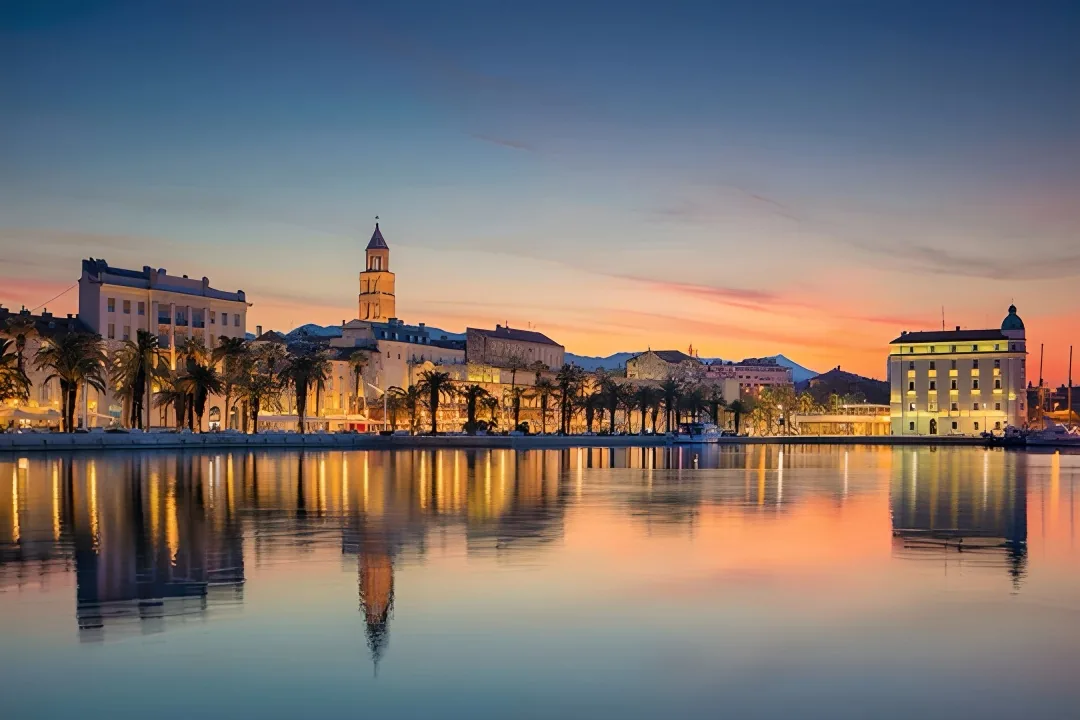
Split’s old quarter grew up inside a palace built by the Roman emperor Diocletian around 1,700 years ago. Today the palace walls hold homes, shops, restaurants and the Cathedral of Saint Domnius, and the whole old quarter is listed by UNESCO. Walk through the Peristyle, the palace’s central square, and climb the bell tower for the best view over the rooftops.
The Riva and Marjan
Split’s main marina lies at the foot of Marjan, and you can explore the hill’s paths straight from the marina gates, a pleasant walk along the water from the old quarter. The Riva is the wide seafront promenade in front of the palace, lined with cafés. Marjan is the wooded hill at the western end of Split, with paths, viewpoints and quiet beaches such as Kašjuni below it.
Bačvice
Bačvice is Split’s best-known city beach, a short walk from the old town. It is where locals play picigin, a game of keeping a small ball in the air while standing in shallow water.
Where to eat
The streets inside the palace are full of wine bars and small restaurants. For a group of 20 or more in July and August, book ahead.
Also worth seeing in Split
The green market, just outside the palace’s east gate, is the best place to see what grows on the Dalmatian coast. The small Temple of Jupiter, inside the palace, is among the best preserved Roman temples in the region. Outside the north gate stands Ivan Meštrović’s statue of Gregory of Nin. Rubbing its big toe is said to bring good luck. Walking tours of the palace run from morning to evening and are a good way to make sense of its 1,700 years of history.
Local tip
Split is busy in summer, especially around midday. Arrive by boat in the afternoon, explore in the evening, and walk the palace early the next morning before you sail, when it is almost empty.
Day 3: Bol on Brač and Stari Grad on Hvar
Day three is spent on the islands, with two very different stops.
The sail
The yacht crosses the Brač channel to the south side of Brač, the island closest to Split, and anchors in a bay near Bol for the first swim.
Zlatni Rat
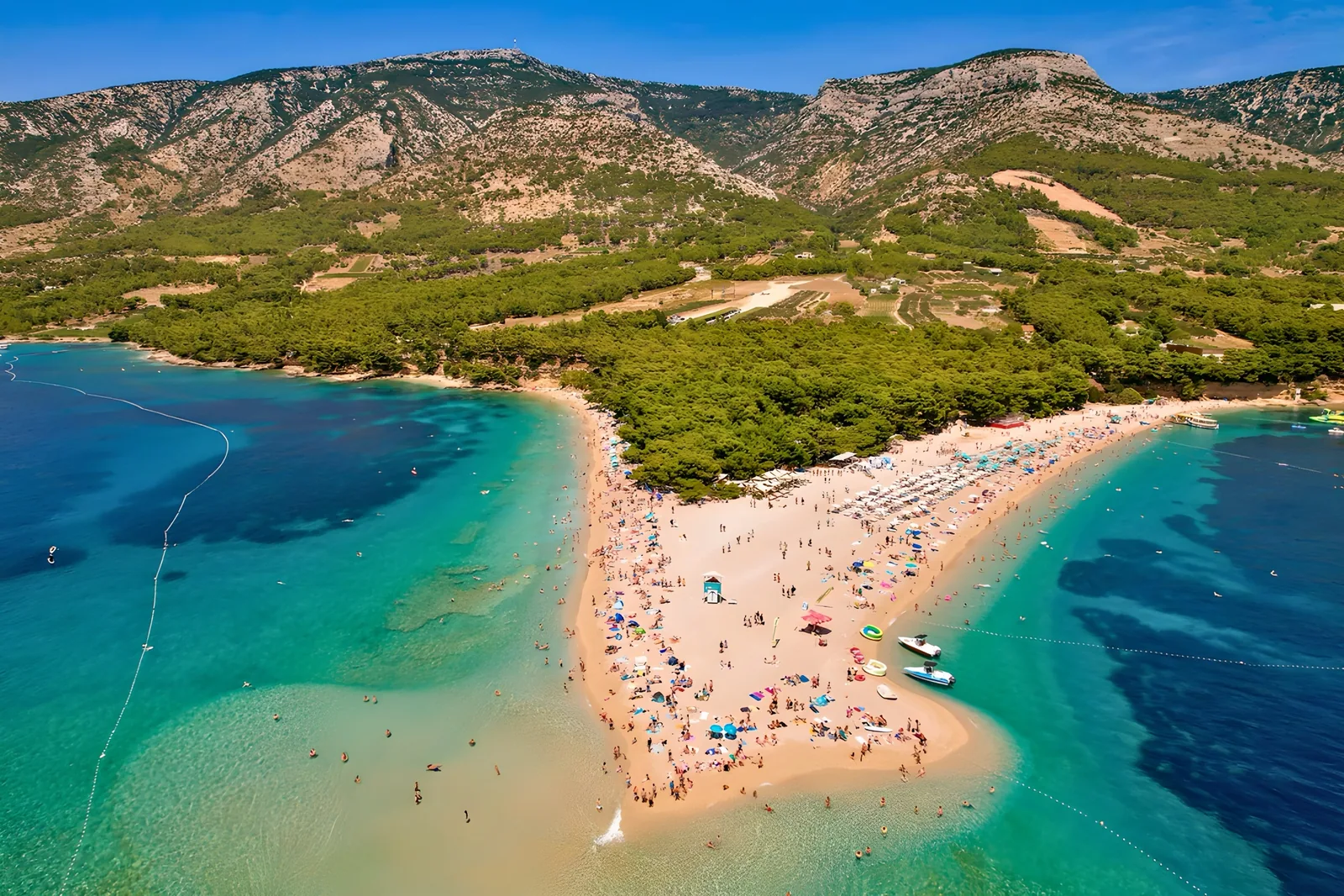
Zlatni Rat, near the town of Bol, is the most photographed beach in Croatia: a long spit of fine pebbles that reaches out into the sea and changes shape with the wind and the current. The water off the point is clear, and the views across to Hvar are some of the best of the week.
Vidova Gora
For walkers, a trail climbs from Bol to Vidova Gora, the highest point on any Adriatic island. The views reach across Hvar to Vis and beyond. It is a long, hot hike, so start early or go in the late afternoon and bring plenty of water.
Stari Grad
In the afternoon the yacht sails across to Hvar and into the long, sheltered bay of Stari Grad. Founded by Greek settlers in 384 BC, it is one of the oldest towns in Europe. The farmland behind the town, the Stari Grad Plain, has been worked in the same field pattern since then and is listed by UNESCO.
Stari Grad is calmer than Hvar Town, on the other side of the island. Its old streets, small squares and waterfront restaurants make for a relaxed evening.
Also worth seeing on Hvar
In Stari Grad, Tvrdalj is the fortified summer house of the 16th-century poet Petar Hektorović, with a fish pond in its courtyard. Hvar is also known for its lavender fields, which flower in early summer, and for its red wine from the Plavac Mali grape. Across the island, Hvar Town has a hilltop fortress with views over the Pakleni Islands, a chain of small islands just offshore that are reached by water taxi.
Local tip
Many groups who want to see Hvar Town take a taxi or a bus across the island for an evening. Ask the crew about the best way to get there and back.
Day 4: Vis
Day four goes further out to sea, to the most remote of the inhabited islands on the route.
The sail
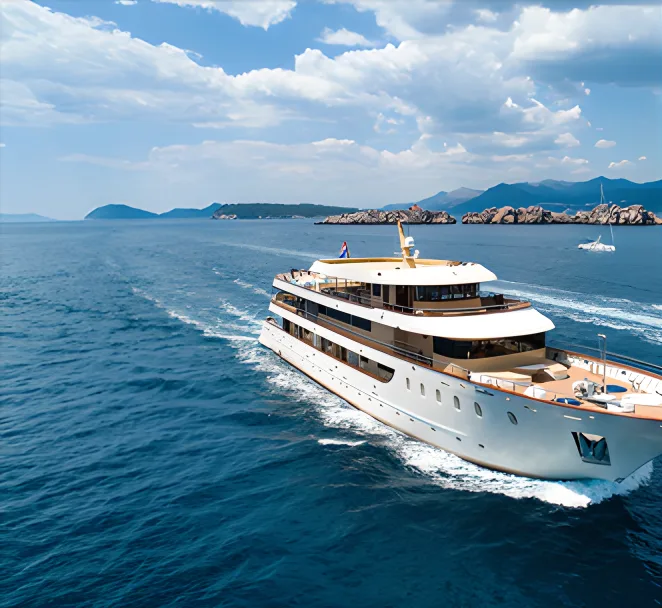
The yacht sails west to Vis, the island farthest from the mainland on this itinerary. It is among the most beautiful sails of the week, with open water and Vis rising ahead. On a clear morning you can see the outline of Biševo and the other small outer isles, long before the yacht reaches the harbor. Keep a camera handy on deck for the approach.
Why Vis feels different
Vis was a military base and closed to foreign visitors until 1989. As a result, it was spared the building boom of the coast, and it still feels quieter than the islands closer to the mainland. Vis Town has Venetian buildings along its harbor, and the fishing village of Komiža sits on the other side of the island.
The Blue Cave
The Blue Cave is on the small island of Biševo, a short boat ride from Vis. Around midday, sunlight enters the cave through an underwater opening and turns the water bright blue. The outing is by small local boat and is paid separately, and it is a morning outing, because the light is best before noon.
Stiniva
Stiniva is a small cove enclosed by tall cliffs, with a narrow opening to the sea. It is among the best-known beaches in Croatia, and it is reached by boat or by a steep path.
Where to eat
Vis is known for fresh fish, local wine and simple, traditional cooking. Its harbor restaurants are some of the best in Croatia.
Also worth seeing on Vis
Vis was the Greek colony of Issa more than 2,000 years ago, and its small museum holds finds from that time. The British held the island in the early 1800s, and their fort still stands above the harbor. During the Second World War, the Yugoslav partisan leader Tito used a cave on Mount Hum as his headquarters. Jeep tours of the island visit several of these places in half a day.
Local tip
Water on the outer islands is often the clearest of the week, and the bays around Vis are the best place to explore below the surface. If your group loves snorkeling, this is the stop to bring masks to the swim stop.
Day 5: Korčula
Day five is a long passage east, to a remarkably well preserved town on the coast.
The sail
The yacht sails from Vis toward Korčula, passing the long south coast of Hvar and the island of Šćedro. Swim stops on this leg are often in quiet bays off the islands along the way.
Korčula Town
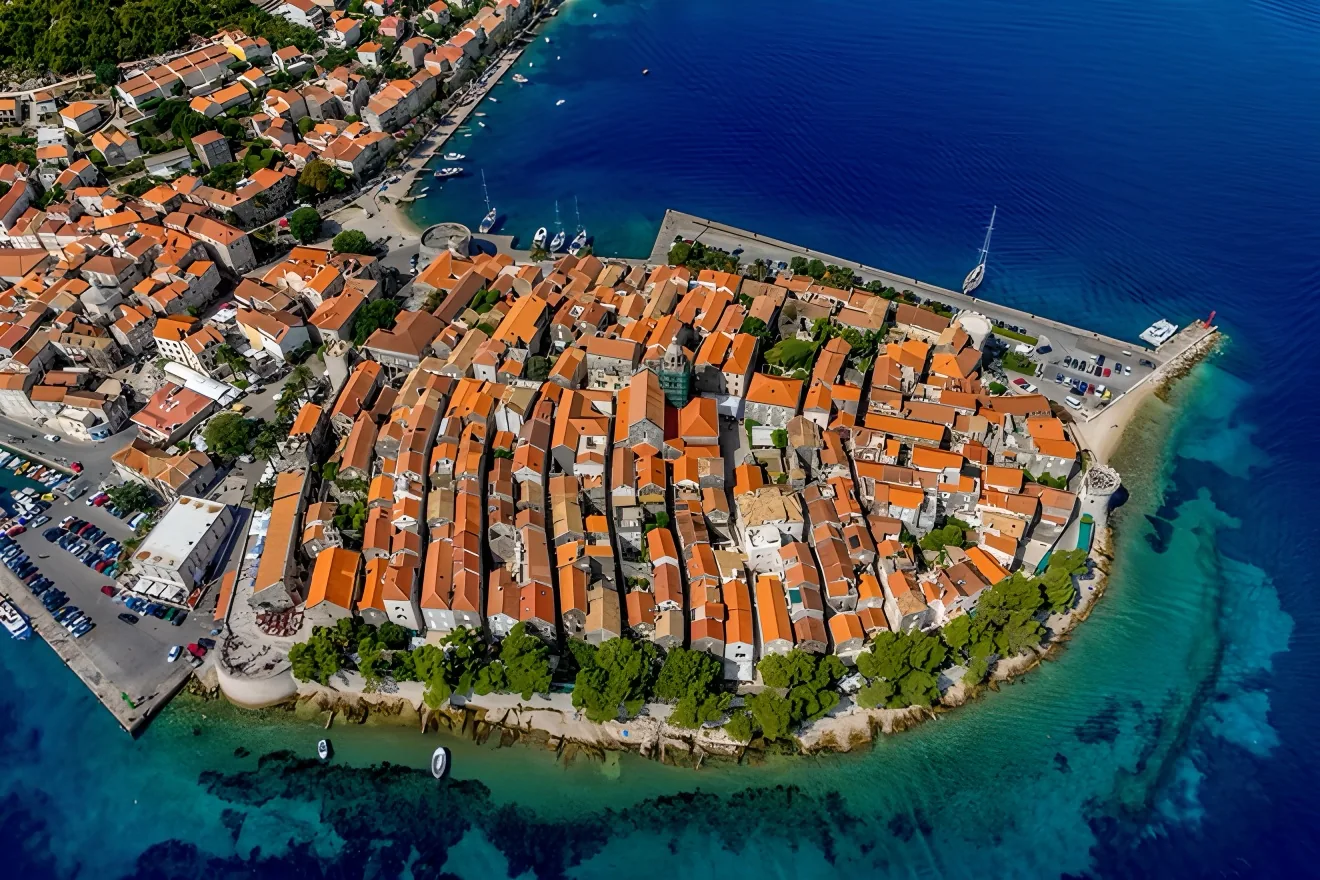
Korčula Town sits on a small peninsula, surrounded by medieval walls and towers. Its streets are laid out like the bones of a fish, which keeps the streets cool in summer and sheltered from the wind. Korčula claims to be the birthplace of Marco Polo, and a small museum tells his story.
Moreška
In summer, Korčula’s sword dance, the Moreška, is performed for visitors on set evenings. It is a centuries-old tradition, and worth planning the evening around if it falls on your date.
Wine
Korčula grows Pošip, a white wine, and Grk, a rare white grape from the village of Lumbarda. A tasting is a good way to spend the late afternoon.
Also worth seeing on Korčula
The house that tradition links to Marco Polo is a short walk from the cathedral, and its tower has views over the old quarter. St. Mark’s Cathedral, in the main square, has a fine stone doorway and works by the Venetian painter Tintoretto. Lumbarda, a few miles east, has sandy beaches, which are rare in Croatia, and family wineries that make Grk.
Local tip
Korčula’s marina sits just outside the old walls, so the whole peninsula is a short stroll from the yacht. Walk the walls at sunset, then have dinner along the western side of the peninsula, which looks out toward the sunset over the channel.
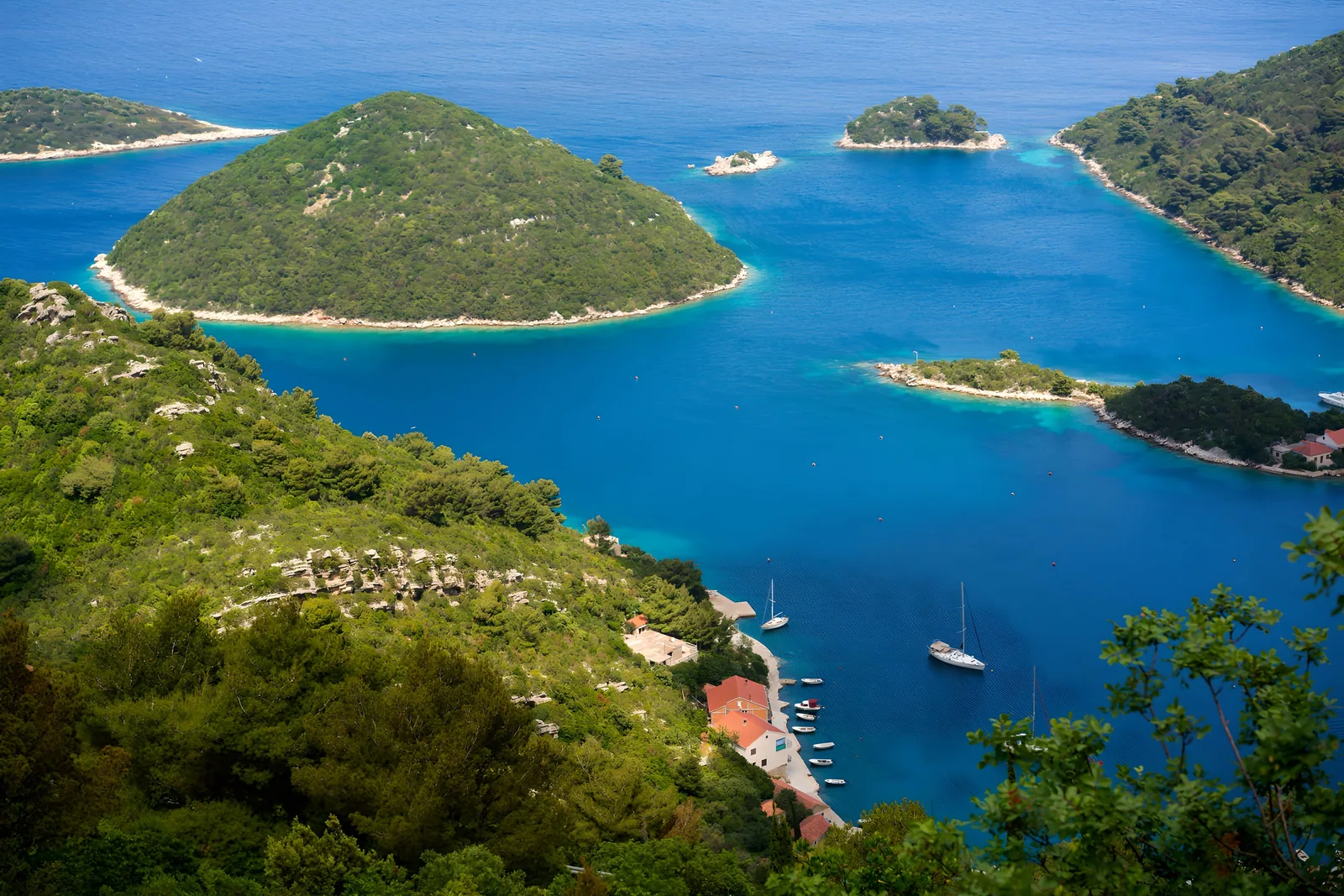
Day 6: Pomena on Mljet
Day six is the quietest stop of the sailing week.
The sail
The yacht sails a short distance south to Pomena, a small harbor at the western end of the island of Mljet, with a swim in a bay on the way.
Mljet National Park
Most of the western part of Mljet is a national park, created in 1960. Its center is two saltwater lakes, Veliko jezero and Malo jezero, connected to the sea and surrounded by pine forest. On a small island in the larger lake stands a Benedictine monastery from the 12th century.
Cycling and walking
Flat paths run along the shores of the lakes, and bikes can be rented near Pomena. Riding is a lovely way to spend a few hours in Croatia, at your own pace, with the chance to swim in the lakes along the way.
Pomena
Pomena itself is little more than a harbor, a few restaurants and the park entrance. After Split, Korčula and Hvar, the quiet is part of the appeal. Enjoy a slow dinner by the water and an early night before the final passage of the week.
Also worth seeing on Mljet
Mljet is among the greenest islands in Croatia, with more than half of the island covered in forest. Local legend says that Odysseus was held on the island for seven years by the nymph Calypso, and a sea cave on the south coast carries his name. Polače, the next village along from Pomena, has the ruins of a Roman palace beside the water.
Local tip
The park charges an entry fee, which includes the boat across to the monastery island. Buy tickets at the entrance or in advance.
Day 7: Dubrovnik
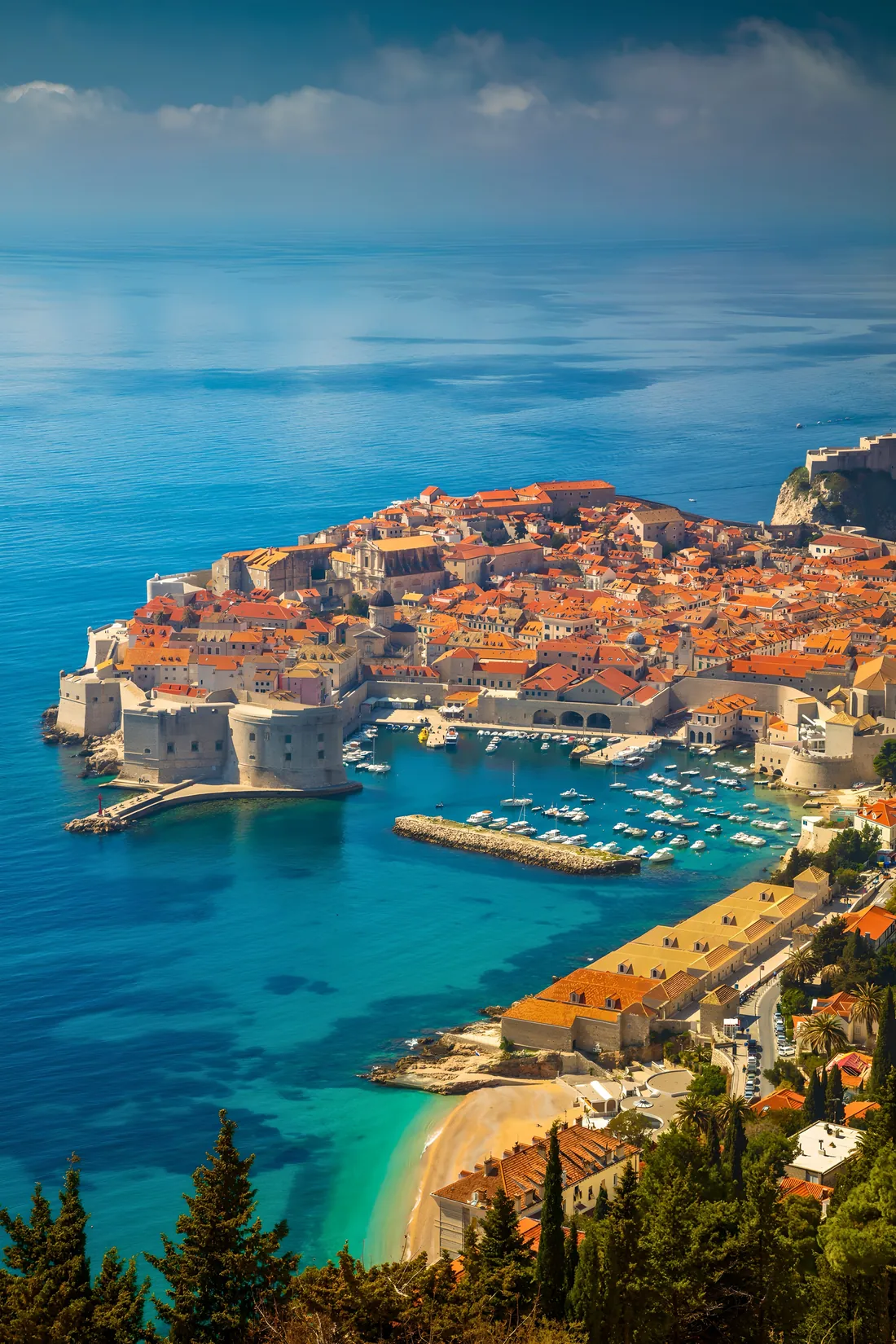
Day seven brings the sailing trip to Croatia’s most famous city.
The sail
The yacht sails south along the Mljet channel and past the Elaphiti Islands toward Dubrovnik. The last swim stop of the week is often in the islands off Dubrovnik.
The old town
Dubrovnik’s old town, listed by UNESCO, is enclosed by stone walls nearly two kilometers long. The main street, the Stradun, runs straight through the center, from the Pile Gate to the old harbor.
Walking the walls
Walking the full circuit of the walls takes one to two hours and is the best way to see Dubrovnik, its red roofs and the sea. It is a ticketed walk, and it is hot in summer. Go early in the morning or late in the afternoon.
Other things to do
Take the cable car up Mount Srđ for the view at sunset. Take the short boat ride to Lokrum, a wooded island just off the old town. Or simply find a table in a quiet square and enjoy the last evening of the sailing week with your group, before the crowds return in the morning.
Also worth seeing in Dubrovnik
The Rector’s Palace was the seat of the old Republic of Ragusa, which governed Dubrovnik for centuries. The Franciscan monastery, near the Pile Gate, has a pharmacy that has been open since 1317, one of the oldest in Europe. Fans of the television series Game of Thrones will recognize many corners of the old quarter, and walking tours of the filming locations run every day.
The captain's dinner
The captain’s dinner is a highlight of the week, and on many sailings it falls near the end. Ask your crew which evening it is.
Local tip
The old town is at its busiest when cruise ships are in port. Arriving by yacht in the afternoon means you can explore in the evening, after the large groups have left.
Day 8: Departure from Dubrovnik
Breakfast is served on board, and the sailing ends in Dubrovnik. Fly home from Dubrovnik’s airport, south of the city, or stay on for a night or two. Book any hotel nights in Dubrovnik early, especially in July and August, when rooms near the old quarter are the first to go and prices climb as the dates get closer.
Food and wine along the route
One of the best parts of a sailing trip in Croatia is that every port has its own food and wine. These are the dishes and wines to look for at each stop.
| Day | Port | What to try |
|---|---|---|
| 1 | Skradin | Skradin risotto, slow-cooked for hours |
| 2 | Split | Pašticada, a Dalmatian beef stew in a sweet wine sauce, and black risotto made with cuttlefish ink |
| 3 | Bol and Stari Grad | Peka, meat or octopus slow-baked under an iron lid, and red wine from the Plavac Mali grape |
| 4 | Vis | Fresh fish grilled simply with olive oil, and Vugava, the island’s white wine |
| 5 | Korčula | Pošip and Grk, the island’s two best-known white wines |
| 6 | Pomena | Local cheese and lamb, and a quiet dinner by the water |
| 7 | Dubrovnik | Oysters from Ston, and red wine from Dingač on the Pelješac peninsula |
Eating in a konoba
A konoba is a small, often family-run restaurant serving traditional local food. Menus are short and built around what was caught or picked that morning. For the best meal, ask what the kitchen recommends rather than ordering from the menu.
Peka needs notice
Peka takes hours to cook, so many restaurants ask you to order it in the morning or the day before. If your group wants peka, ask your crew to help call ahead.
Wine tastings
Tastings can be arranged near many of the ports on this route. Wine lovers can taste a different island’s wine at every stop.
Getting around ashore
Every port on this itinerary is easy to explore on foot from the harbor. For longer trips, there are a few other options.
Walking
The old quarters of Split, Stari Grad, Korčula and Dubrovnik are made for walking, and most are closed to cars. Wear shoes with good grip, because the stone is smooth and can be slippery.
Taxis
Taxis are easy to find in Split and Dubrovnik and available in most of the island towns. On Hvar, a taxi is the simplest way to get from Stari Grad to Hvar Town and back for an evening.
Bikes
Bikes can be rented in several ports, and Mljet is the best place on the route to ride, with flat paths around the lakes.
Small boats
Water taxis and small local boats run to places a large yacht cannot reach, such as the Blue Cave on Biševo, the Pakleni Islands off Hvar and the island of Lokrum off Dubrovnik.
Guided tours
Walking tours in Split and Dubrovnik and jeep tours on Vis are a good way to see a lot in a short time. They are paid separately and can be booked locally.
Other ways to sail this coast in seven days
The Šibenik to Dubrovnik route is the best fit for a first sailing trip in Croatia, but it is not the only one.
The same route in reverse
Sea Sun’s yachts also sail from Dubrovnik to Šibenik. The ports are similar, and the week ends with Krka instead of Dubrovnik. Pick the direction that gives your group the best flights.
A round trip from Šibenik
A round trip from Šibenik keeps the week in central Dalmatia and ends where it began, which can make flights simpler. Ports on Sea Sun’s routes in this part of the coast include Primošten, Trogir, Maslinica on Šolta, Zlarin, Jelsa and Hvar Town, as well as Split and the islands of Brač and Hvar.
A northern route from Opatija
A northern sailing from Opatija, on the Kvarner Gulf, works south toward Šibenik through quieter islands. It suits groups who have seen Split and Dubrovnik before.
A wine route
A wine-focused trip can add stops such as the Grgich winery in Trstenik on the Pelješac peninsula, along with wineries on Korčula and Brač and near Šibenik.
Planning a private charter itinerary
On a private yacht charter in Croatia, Jason gathers what matters to your group, from ages and interests to the pace you want, and helps plan the route around it. Ports always depend on the weather and the captain’s judgment.
Want to sail this route with your group? Call Jason at (404) 465-4081.
Where to stay before and after the sailing
Most travelers add a night or two in Croatia on each side of the sailing trip. These are the best places to stay, and why.
Trogir, before
Trogir is the easiest first night in Croatia. It is close to Split’s airport, small enough to explore in an evening, and quieter than Split. Its old quarter sits on a small island joined to the mainland and to the island of Čiovo by bridges, and its cathedral and waterfront are among the finest in Dalmatia. From Trogir, the drive north to Šibenik for boarding is straightforward.
Split, before
Split suits travelers who want a city first: more restaurants, more nightlife and the palace on the doorstep. The sailing trip calls at Split early in the week, so if you stay in Split before boarding, consider Trogir or Šibenik instead to see somewhere new.
Šibenik, before
Staying in Šibenik means no travel on boarding morning. It is the most relaxed choice for a group, and the old quarter around the cathedral is lovely in the evening.
Dubrovnik, after
Most travelers stay at least one night in Dubrovnik after the sailing. Hotels inside or close to the old quarter are the most convenient and the most expensive. Lapad, a short bus or taxi ride to the west, is quieter and has beaches. Cavtat, a small harbor south of Dubrovnik, is close to the airport and makes an easy last night before an early flight.
Marinas, harbors and nights in port
On this itinerary, the yacht spends every night in a harbor, at a town quay or in a marina. That is a big difference between a sailing trip on a larger yacht and a week on a small boat that anchors in bays.
What a night in port means
You can step ashore whenever you like, walk ashore for dinner and come back as late as you want. There is no small boat to catch and no need to plan the evening around the crew.
Marina or town quay
Every port on this route has its own mix of marina berths and quay space, from a full-service marina to a stretch of old stone quay, and the crew handles all of it. Some ports have a marina, with berths for yachts of all sizes, water and power, and often showers and a café. Others have a quay along the waterfront in the center. Skradin’s marina sits right beside the old quarter. In Split, Korčula and Dubrovnik, both kinds of berth are in use. Where the yacht ties up depends on the port, the date and the size of the yacht.
Noise
A marina berth in the center of a busy port, such as Hvar Town or Split, can be lively until late on summer nights. A marina outside the center is usually quieter, and a berth in a small harbor such as Pomena is quietest of all. Earplugs are worth packing for light sleepers.
Swim stops: what to expect
The daily swim stop is many people’s favorite part of a sailing trip in Croatia.
The water
The Adriatic along the Dalmatian coast is famously clear. The sea is coolest in May, warms through June and is at its warmest in late July, August and early September. By October it is cooling again but still swimmable in the sunshine.
The bays
Swim stops are usually in a sheltered bay along the islands, chosen fresh each day by the captain for the wind and the sea. Many have pebble or rock shores rather than sand.
Safety
Wear water shoes near rocks, because sea urchins are common in shallow rocky water. Swim near the yacht, and follow the crew’s instructions about where to swim and when to come back on board.
Bays worth knowing
The captain chooses each swim stop on the day, but a few bays along this coast are famous in their own right. Stiniva bay on Vis is enclosed by cliffs. Srebrna bay, also on Vis, has smooth white pebbles. The Pakleni isles off Hvar have several sheltered bays with clear, shallow water. Saplunara bay, at the eastern end of Mljet, has one of the few sandy beaches on the route, and Šunj bay on Lopud, near Dubrovnik, is another. If one of these is on your wish list, mention it to the crew, and they will tell you whether the wind and the route allow it.
Water toys
Water toys without a motor, such as paddleboards and snorkel sets, are included on Sea Sun’s sailings and come out at the swim stops. The clearest water of the week is usually around Vis.
How to adapt the itinerary for your group
The same seven days can feel very different depending on who is on board. On a private charter, these are the changes groups ask for most.
For first-time visitors
Keep the classic route. Spend the most time ashore in Split, Korčula and Dubrovnik, and see Krka at the start.
For families with teenagers
Add more time in the water. Zlatni Rat, the swim stops off Vis and the lakes on Mljet are the days teenagers enjoy most. Bikes on Mljet are a hit.
For wine lovers
Add tastings on Hvar, Korčula and the Pelješac peninsula, and plan the dinners ashore around local wines. A wine route can include the Grgich winery in Trstenik.
For an active group
Hike to Vidova Gora above Bol, cycle on Mljet, swim at every stop and walk Dubrovnik’s walls at sunrise.
For a wedding or celebration
Plan the captain’s dinner as the celebration dinner, and keep one evening in Korčula or Dubrovnik for a private dinner ashore.
For a company retreat
Keep the mornings free for a short meeting on deck if the group needs one, and plan one shared dinner ashore for the whole team.
Weather and the best time for this itinerary
The season
Sea Sun’s sailings in Croatia run from early May to mid-October. June and September are the best months for many groups: warm water, long days and fewer crowds than July and August. July and August are the warmest and busiest weeks, and the water is at its warmest late in the summer.
Wind
Summer sailing weather in Croatia is usually calm. A northwest breeze, the maestral, often picks up in the afternoon and dies down in the evening. Stronger winds, such as the bura from the northeast and the jugo from the southeast, are less common in summer. When they blow, the captain may change the order of the ports or pick a more sheltered bay for the swim stop.
Heat
July and August are hot ashore, especially in Split and Dubrovnik. Plan walks and visits for the early morning and the late afternoon, and spend the hottest hours on the water.
Mistakes to avoid on a seven-day sailing itinerary
Trying to see everything
Croatia has more than a thousand islands, and a week is not enough for all of them. The groups who enjoy the week most are the ones who choose one stretch of coast and see it well.
Visiting the famous places at midday
Krka, Split’s palace and Dubrovnik’s walls are at their most crowded and hottest around midday. Plan them for the early morning or the late afternoon, and enjoy the swim stop in the middle of the day instead.
Missing the Blue Cave's light
The Blue Cave is only bright blue around midday, when the sun is high. Plan the boat trip from Vis for late morning.
Booking the last hotel too late
The sailing ends in Dubrovnik, and Dubrovnik hotels fill up early in summer. Book the night after the sailing at the same time as the cabin or the charter.
Bringing a hard suitcase
There is little room for a hard case in a cabin. Bring a soft bag that folds flat under the bed.
Forgetting how marinas work
In a busy marina or harbor, yachts come and go through the afternoon. If you go ashore, keep the crew’s phone number with you, and check what time the yacht leaves in the morning.
Not checking the flights first
A one-way route means two different airports. Check the flights before you choose the direction of the sailing, not after.
Tips for planning your seven days
Book the extras that sell out
Krka tickets, the Blue Cave boat, Dubrovnik’s walls and dinners for a large group in Split and Dubrovnik are worth booking ahead in peak season.
Leave some time unplanned
The best moments of a sailing trip are often the unplanned ones: a long lunch, a second swim, an evening that runs late. Do not fill every hour.
Choose your cabin with the stairs in mind
There is no elevator on the yacht. If a guest has trouble with stairs, choose their cabin early.
Think about the cost of time ashore
National parks, small-boat trips, tastings and dinners ashore are paid separately. Our guide to how much a yacht charter in Croatia costs shows how to budget for them, and our guide to what an all-inclusive charter covers lists what is part of the price.
Questions about a seven-day sailing trip in Croatia
Is seven days enough to sail Croatia?
Seven days is enough to sail from Šibenik to Dubrovnik and see the highlights of the Dalmatian coast. It is not enough to see all of Croatia’s islands, which number more than a thousand, so most groups pick one region per trip.
Do I need sailing experience?
No. On a crewed sailing week, the captain and crew sail the yacht. You do not need a license or any experience on a boat.
How long are the sailing legs each day?
Most legs on this route are a few hours, with a swim stop in between. The longest are usually the legs to Split and to Korčula.
Will we spend nights at anchor?
Not on this itinerary. The yacht spends every night in port, so you can walk ashore in the evening.
Is the route fixed?
On Sea Sun’s set sailings, the route is set in advance, though ports can change for weather. On a private charter of the whole yacht, the route can be planned with your group.
Can we start in Split instead of Šibenik?
This sailing begins in Šibenik and calls at Split on day two. Many travelers fly into Split, spend a night in Split or Trogir, and travel to Šibenik for boarding.
Can we sail for longer than seven days?
Sea Sun’s sailings in Croatia are seven nights. Many travelers add nights in Trogir, Split or Šibenik before the sailing and in Dubrovnik after it, which turns the trip into ten days or more in Croatia.
Is there Wi-Fi on board?
Yes. Wi-Fi is included on Sea Sun’s sailings. Coverage can drop in remote bays, so plan important calls for time in port.
Is this sailing week good for families?
The minimum age on board is 12, and there is no elevator. For families with teenagers, it is a very good fit.
Summary: the best seven days of sailing in Croatia
A seven-day sailing trip from Šibenik to Dubrovnik covers the best of the Dalmatian coast in a single week: Krka’s waterfalls, Split’s Roman palace, the beaches of Brač, the old towns of Hvar and Korčula, remote Vis, the lakes of Mljet and the walls of Dubrovnik. Each day has a sail, a swim and a new harbor to explore, and each night is spent in port.
Book the popular extras ahead, leave time unplanned and choose the direction that gives you the best flights. Then let the crew do the sailing.
Sail this itinerary with Sea Sun Vacations
Book a cabin on one of Sea Sun’s sailings, or charter the whole yacht for your group. Jason will help you choose the dates and the route.
Call (404) 465-4081, email [email protected], or see current sailing dates and prices.